Tel: +86-15866558545 E-mail: trevekoliu@qq.com
- All
- Product Name
- Product Keyword
- Product Model
- Product Summary
- Product Description
- Multi Field Search

 |


| Quantity: | |
|---|---|
I. Equipment Introduction
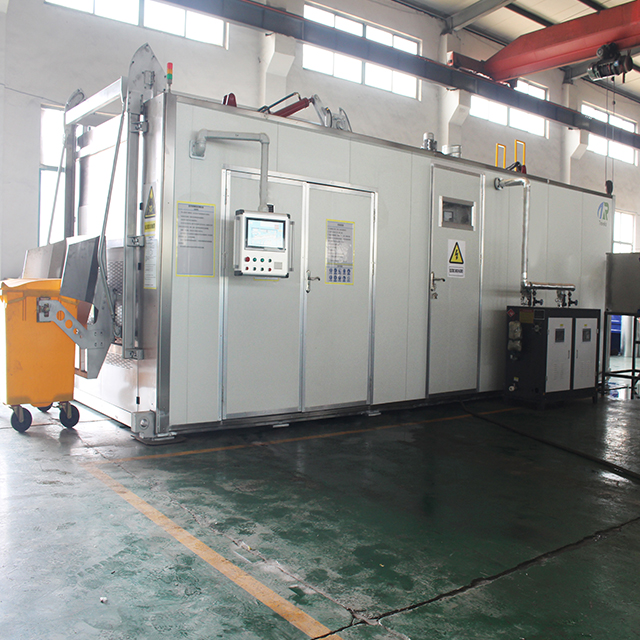
Microwave disinfection equipment for medical waste is a device that utilizes the synergistic disinfection of microwave irradiation and saturated steam. It kills bacteria using the heat of steam, the thermal effect of microwaves, and the biological action of microwaves, particularly the biological sterilization effect of microwaves. This equipment meets the requirements of HJ/T229—2006 "Technical Specification for Centralized Treatment Engineering of Medical Waste Microwave Disinfection". Microwave disinfection technology for medical waste is suitable for treating infectious waste, sharps waste, and pathological waste listed in the "Medical Waste Classification Catalog"; however, it is not suitable for treating pharmaceutical waste or chemical waste listed in the "Medical Waste Classification Catalog". The TR -MWT model of this equipment is designed as a single-person, automated system. All components of the TR -MWT model are enclosed in a sandwich-core flame-retardant panel enclosure. This design aims to protect the operator and allow for emergency use in outdoor environments under a simple rain shelter.
This integrated medical waste microwave treatment equipment mainly consists of an automatic feeding unit, a sealed silo unit, a multi-functional sealed double-layer crushing unit, a microwave sterilization unit, a discharge unit, an automatic control unit, a waste gas treatment unit, and a wastewater treatment unit. This integrated mobile medical waste microwave sterilization equipment can handle infectious waste, sharps waste, and pathological waste (excluding human organs and infectious animal carcasses) listed in the "Medical Waste Classification Catalog." Microwave sterilization technology for medical waste is not suitable for handling pharmaceutical or chemical waste listed in the "Medical Waste Classification Catalog." The automatic feeding module feeds medical waste from standard medical waste bins into the sealed silo; the multi-functional sealed double-layer crushing module crushes and reduces the volume of medical waste in the sealed silo, turning it into smaller pieces; these smaller pieces then enter the microwave sterilization chamber; the microwave sterilization chamber... The system includes a material mixing module that evenly and thoroughly mixes small pieces of medical waste and chemicals within the microwave sterilization chamber. A microwave generator is installed within the chamber to produce electromagnetic waves of the corresponding frequency wavelength. A steam generator is located next to the chamber, producing high-temperature, high-pressure steam, which is then piped into the chamber. The interaction between the high-temperature, high-pressure steam and the electromagnetic waves completes the sterilization of the medical waste. The sterilized waste is smaller in volume and lighter in weight, with viruses and bacteria effectively killed, transforming it into ordinary household waste for further centralized processing.
 |  |
II. Equipment Technical Features
This equipment uses high-frequency microwave sterilization technology to treat medical waste. Its principle is to kill bacteria using the heat of steam, the thermal effect of microwaves, and the biological action of microwaves. Microwaves affect the electron and ion density around the bacterial membrane by manipulating the distribution of electrons on the bacterial membrane cross-section, thereby altering the cell membrane's permeability. As a result, bacteria become malnourished, unable to metabolize normally, and their growth and development are hindered, leading to death. From a biochemical perspective, the nucleic acids (RNA) and deoxyribonucleic acid (DNA) that bacteria use for normal growth and reproduction are coiled macromolecules tightly linked by numerous hydrogen bonds. Microwaves can cause these hydrogen bonds to loosen, break, and recombine, thus inducing genetic or chromosomal aberrations or breaks. Microwave sterilization utilizes electromagnetic field effects and biological effects to kill microorganisms. Practice has proven that microwave devices have significant advantages in sterilization temperature, sterilization time, and energy saving. They achieve thorough sterilization by utilizing the rapid spectral characteristics of microwaves. Its outstanding features include:
Energy saving—superior to steaming and boiling methods. In steaming and boiling, heat is transferred from the surface of the object to the interior first, while microwaves can directly heat the interior, providing uniform heating. When treating waste, microwaves have strong penetrability and can penetrate the interior of the object instantly, generally saving 30% to 50% of electricity.
※A. Uniform and Thorough—Conventional thermal sterilization starts from the surface of the material and then penetrates to the interior through heat conduction. A temperature difference exists between the inside and outside of the material, resulting in inconsistent sterilization effects. Internal sterilization is often less than ideal. Microwaves, with their penetrating properties, act on both the surface and the interior simultaneously, ensuring that the internal and external temperatures reach the required values at the same time, thus achieving uniform and thorough sterilization.
※B. Broad-spectrum sterilization: Microwaves have the same effect on all organisms without selectivity, and can kill a variety of microorganisms and pathogens.
※C. Rapid Action – Conventional thermal sterilization transfers heat from the surface to the interior of an object through conduction, convection, or radiation. However, reaching the required dryness and sterilization temperature inside the object often takes a considerable amount of time. Microwave heating, on the other hand, is characterized by rapid action. The medium is composed of polar and non-polar molecules. Under the influence of an electromagnetic field, these polar molecules shift from a random distribution to an orientation aligned with the polarity of the electric field. Under the influence of a high-frequency electromagnetic field, these orientations change continuously according to the frequency of the alternating electromagnetic field. This process causes molecular motion and friction, generating heat. The field energy of the alternating electric field is then converted into thermal energy within the medium, causing its temperature to rise continuously. Therefore, microwave heating generates heat by the medium material itself losing its electric field energy. Consequently, microwave heating significantly reduces processing time; under a certain power density, sterilization is typically achieved in just tens of seconds or minutes.
※D. Easy to operate—Microwave sterilization equipment is designed with a high degree of automation, and one operator can complete all the work.
※E. Minimal Environmental Pollution—Microwave sterilization does not produce acidic gases or dioxins. The sterilized waste is non-toxic and leaves no residue. Microwave sterilization solves the problems of requiring a small working environment and floor space, does not generate high temperatures in the surrounding environment, and is clean and hygienic. This equipment can solve the problem of on-site harmless treatment of medical waste generated by medical institutions, avoiding secondary pollution to the environment during external treatment and transportation of medical waste, while also reducing the cost of medical waste disposal.
III. Process Flow
The microwave sterilization equipment adopts a fully automated processing system consisting of hydraulic lifting, material crushing, microwave sterilization, and spiral discharge, with a processing capacity of 3-10 t/d and a sterilization rate of ≥99.99%. The automatic feeding device lifts the bin containing medical waste to the feed hopper, and the hopper door automatically opens. The material enters the crushing system from the bin, and then the hopper door automatically closes. The crushing device crushes the medical waste into fragments. The microwave sterilization system and spiral conveying system are then activated. After microwave irradiation and steam-assisted heating, the medical waste sterilization process is completed. Simultaneously, the waste gas generated during the process is automatically collected and treated. After sterilization, the medical waste is transported to a storage hopper outside the equipment via a conveying system.
IV. Equipment Advantages
●Small footprint and low noise: The integrated design of the equipment results in a small footprint and low noise. Both fixed and mobile versions of the equipment are available.
●Low operating temperature and slow heat loss: If microwaves and ordinary heating produce the same amount of sterilization, the temperature reached on the object is significantly lower with microwaves than with ordinary heating. Waste sterilized by microwaves is non-toxic, leaves no residue, and suffers minimal damage .
●Microwave sterilization offers rapid penetration and excellent sterilization results: Microwave disinfection technology utilizes the characteristics of short disinfection time, high speed, strong penetration, uniform temperature inside and outside, energy saving, and good disinfection effect. Through the microwave field, cell structure is destroyed, disrupting the balance of substances inside and outside the cell, leading to cell death; the combination of microwaves and water vapor makes the disinfection effect even more effective.
●Featuring an integrated design and compact arrangement of process equipment, this highly automated system boasts a user-friendly automatic control system that operates automatically and displays operating parameters and status in real time. Utilizing a PLC-based automatic control system, the entire microwave sterilization process is automated, including automatic feeding, crushing, heating, steam injection, automatic microwave sterilization activation, automatic material conveying, and automatic waste gas collection and treatment. A touchscreen on the control panel displays parameters for each system node in real time, allowing operators to easily perform various operations through human-machine interaction, ensuring the correct and reliable operation of the medical waste microwave steam sterilization equipment. The control system can be switched between manual and automatic control modes.
●No dioxins or odorous gases are produced, and there is no wastewater discharge: The waste gas treatment system of the mobile medical waste treatment equipment consists of a waste gas collection hood, waste gas pipelines, and a cyclone + UV photocatalytic oxidation tower waste gas treatment system. The waste gas collection hood mainly consists of a lifting medical waste bin for collection, a sealed crusher with a closed cover for collection, a sealed crusher negative pressure collection port, and a primary screw conveyor for waste gas collection. After collection, the waste gas is combined with "primary membrane filtration and secondary high-efficiency membrane filtration + activated carbon adsorption" before being sent to the "cyclone tower + UV photocatalytic oxidation" waste gas treatment system. Its waste gas emission indicators should meet the national standard "Odor Pollutant Emission Standard" (GB14554-93).
V. Equipment Parameters
model | Processing capacity ( kg/h ) | Processing capacity ( T/d ) | Sterilization chamber capacity (m³) | Power (kW) | External dimensions (mm) |
TR -MWT-100 | 100 | 1.5 | 1m³ | 88KW | 5800*2200*2500 |
TR -MWT-200 | 200 | 3.0 | 2m³ | 105KW | 6800*2400*2800 |
TR -MWT-300 | 300 | 5.0 | 3m³ | 118KW | 11600*3000*2800 |
TR -MWT-400 | 600 | 10.0 | 6m³ | 120KW | 13600*3000*2800 |


