Tel: +86-15866558545 E-mail: trevekoliu@qq.com
- All
- Product Name
- Product Keyword
- Product Model
- Product Summary
- Product Description
- Multi Field Search

 |


| Quantity: | |
|---|---|
I. Equipment Introduction
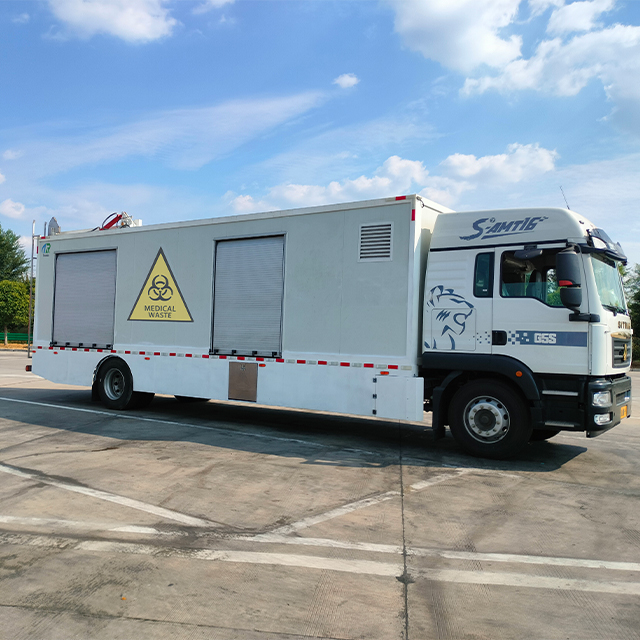
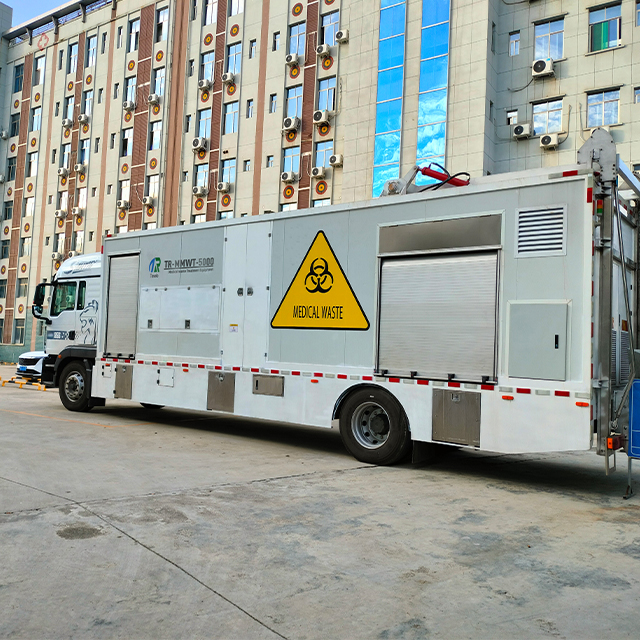
This type of mobile medical waste microwave treatment equipment, also known as a vehicle-mounted medical waste microwave treatment system, is a targeted, convenient, and practical emergency treatment device developed by our company. It is primarily used to address sudden increases in medical waste generation due to major epidemic outbreaks or unexpected disasters, or to handle medical waste disposal equipment damaged by disasters. It is transported by light trucks to hospitals in disaster areas for mobile treatment, ensuring that high-risk medical waste generated by hospitals does not leave the hospital and is completely and harmlessly treated in a short time.
The core equipment of this system is a medical waste microwave sterilizer. The core technology is to treat waste by means of high-temperature microwave sterilization, namely moist heat sterilization. Microwaves are used as the working medium. They have strong penetrating power and can penetrate deep into the interior of the items to be sterilized. The latent heat contained in the steam is released, which causes the items to heat up rapidly to the sterilization temperature and maintain it for a period of time. This causes the proteins in the bacteria to coagulate and deform, thereby killing all microorganisms, including bacterial spores.
This integrated medical waste microwave treatment equipment mainly consists of an automatic feeding unit, a sealed silo unit, a multi-functional sealed double-layer crushing unit, a microwave sterilization unit, a discharge unit, an automatic control unit, a waste gas treatment unit, and a wastewater treatment unit. This integrated mobile medical waste microwave sterilization equipment can handle infectious waste, sharps waste, and pathological waste (excluding human organs and infectious animal carcasses) listed in the "Medical Waste Classification Catalog." Microwave sterilization technology for medical waste is not suitable for handling pharmaceutical or chemical waste listed in the "Medical Waste Classification Catalog." The automatic feeding module feeds medical waste from standard medical waste bins into the sealed silo; the multi-functional sealed double-layer crushing module crushes and reduces the volume of medical waste in the sealed silo, turning it into smaller pieces; these smaller pieces then enter the microwave sterilization chamber; the microwave sterilization chamber... The system includes a material mixing module that evenly and thoroughly mixes small pieces of medical waste and chemicals within the microwave sterilization chamber. A microwave generator is installed within the chamber to produce electromagnetic waves of the corresponding frequency wavelength. A steam generator is located next to the chamber, producing high-temperature, high-pressure steam, which is then piped into the chamber. The interaction between the high-temperature, high-pressure steam and the electromagnetic waves completes the sterilization of the medical waste. The sterilized waste is smaller in volume and lighter in weight, with viruses and bacteria effectively killed, transforming it into ordinary household waste for further centralized processing.
 |  |  |
Technical principle:
Microwave sterilization is the result of the combined effects of microwave thermal and biological effects, allowing microwave energy to interact directly with bacteria for rapid sterilization.
● Thermal effect of microwave energy: Under the influence of a microwave field of a certain intensity, bacteria absorb microwave energy and heat up due to the presence of polarized molecules, thereby denaturing proteins and causing them to lose their biological activity. The thermal effect of microwaves mainly serves to rapidly heat up and kill bacteria.
● Non-thermal effects of microwave energy: The high-frequency electric field alters the polarization molecular structure, causing mutations in proteins and physiologically active substances within microorganisms, leading to loss of vitality or death. This plays a unique role in sterilization that is not present in conventional physical sterilization.
II. Equipment Technical Features
This equipment uses high-frequency microwave sterilization technology to treat medical waste. Its principle is to kill bacteria using the heat of steam, the thermal effect of microwaves, and the biological action of microwaves. Microwaves affect the electron and ion density around the bacterial membrane by manipulating the distribution of electrons on the bacterial membrane cross-section, thereby altering the cell membrane's permeability. As a result, bacteria become malnourished, unable to metabolize normally, and their growth and development are hindered, leading to death. From a biochemical perspective, the nucleic acids (RNA) and deoxyribonucleic acid (DNA) that bacteria use for normal growth and reproduction are coiled macromolecules tightly linked by numerous hydrogen bonds. Microwaves can cause these hydrogen bonds to loosen, break, and recombine, thus inducing genetic or chromosomal aberrations or breaks. Microwave sterilization utilizes electromagnetic field effects and biological effects to kill microorganisms. Practice has proven that microwave devices have significant advantages in sterilization temperature, sterilization time, and energy saving. They achieve thorough sterilization by utilizing the rapid spectral characteristics of microwaves.
Its outstanding features include:
Energy saving—superior to steaming and boiling methods. In steaming and boiling, heat is transferred from the surface of the object to the interior first, while microwaves can directly heat the interior, providing uniform heating. When treating waste, microwaves have strong penetrability and can penetrate the interior of the object instantly, generally saving 30% to 50% of electricity.
※A. Uniform and Thorough— Conventional thermal sterilization starts from the surface of the material and then penetrates to the interior through heat conduction. A temperature difference exists between the inside and outside of the material, resulting in inconsistent sterilization effects. Internal sterilization is often less than ideal. Microwaves, with their penetrating properties, act on both the surface and the interior simultaneously, ensuring that the internal and external temperatures reach the required values at the same time, thus achieving uniform and thorough sterilization.
※B. Broad-spectrum sterilization: Microwaves have the same effect on all organisms without selectivity, and can kill a variety of microorganisms and pathogens.
※C. Rapid Action – Conventional thermal sterilization transfers heat from the surface to the interior of an object through conduction, convection, or radiation. However, reaching the required dryness and sterilization temperature inside the object often takes a considerable amount of time. Microwave heating, on the other hand, is characterized by rapid action. The medium is composed of polar and non-polar molecules. Under the influence of an electromagnetic field, these polar molecules shift from a random distribution to an orientation aligned with the polarity of the electric field. Under the influence of a high-frequency electromagnetic field, these orientations change continuously according to the frequency of the alternating electromagnetic field. This process causes molecular motion and friction, generating heat. The field energy of the alternating electric field is then converted into thermal energy within the medium, causing its temperature to rise continuously. Therefore, microwave heating generates heat by the medium material itself losing its electric field energy. Consequently, microwave heating significantly reduces processing time; under a certain power density, sterilization is typically achieved in just tens of seconds or minutes.
※D. Easy to operate— Microwave sterilization equipment is designed with a high degree of automation, and one operator can complete all the work.
※E. Minimal Environmental Pollution— Microwave sterilization does not produce acidic gases or dioxins. The sterilized waste is non-toxic and leaves no residue. Microwave sterilization solves the problems of requiring a small working environment and floor space, does not generate high temperatures in the surrounding environment, and is clean and hygienic. This equipment can solve the problem of on-site harmless treatment of medical waste generated by medical institutions, avoiding secondary pollution to the environment during external treatment and transportation of medical waste, while also reducing the cost of medical waste disposal.
III. Equipment Advantages
※1. The equipment features an integrated design, a small footprint, and low noise.
※2. The equipment is highly automated, requiring only one person to operate the entire set of equipment, thus saving labor costs.
※3. Low energy consumption: the entire set of equipment only requires electric power. Taking a daily processing capacity of 5 tons as an example, the total installed power is only 117 kilowatts.
※4. The medical waste disposal method is flexible, and medical waste can be disposed of at any time. The equipment can be shut down after disposal, minimizing energy consumption and personnel costs, and saving disposal costs.
IV. Equipment Parameters
Serial Number | System Unit | project | Technical parameters | |
model | TR-M MWT-3000 | TR-MMWT5000 | ||
1 | feeding system | garbage can | 660L | 660L |
Power source | 4kW hydraulic system, working pressure: 15MPa, top cover linkage start. | 4kW hydraulic system , working pressure: 15MPa Top cover linkage start | ||
Material | Stainless steel | Stainless steel | ||
2 | silo | volume | 1m³ | 1m³ |
Material | 4mm stainless steel | 4mm stainless steel | ||
Press | 0.55kW variable frequency motor Equipped with K- series hardened tooth surface reducer Matching limit controller | 0.55kW variable frequency motor Equipped with K- series hardened tooth surface reducer Matching limit controller | ||
3 | Crushing system | power | 22kw | 30kW |
speed reducer | KA-127 Hardened Gear Reducer | KA-157 Hardened Gear Reducer | ||
blade | Φ345*30 D550 imported material | Φ345*30 D550 imported material | ||
spindle | Standard heat treatment process for Φ150 round steel | Standard heat treatment process for Φ150 round steel | ||
Crushing chamber size | 647mm*665mm | 647mm*665mm | ||
4 | Sterilization chamber | Spindle power | 2.2kw | 3kw |
speed reducer | KA127R77 Hardened Gear Reducer | KA127R77 Hardened Gear Reducer | ||
blade | 10mm/ Stainless Steel | 10mm/ Stainless Steel | ||
Storage specifications | Φ530-5000 , thickness 8mm , 304 stainless steel | Φ530-6000 , thickness 8mm , 304 stainless steel | ||
microwave generator | 1.5kw * 8 units | 1.5kw * 10 units | ||
5 | discharge screw | power | 3kw | 3kw |
speed reducer | KAB87 Hardened Gear Reducer | KAB87 Hardened Gear Reducer | ||
blade | 8mm/ Stainless Steel | 8mm/ Stainless Steel | ||
6 | Matching steam / cooling system | Steam generator | 54kw Steam production capacity: 75 kg/h | 72kw Steam production capacity: 100 kg/h |
water tank | 0.5m³/304 material | 0.5m³/304 material | ||
water softener | / | / | ||
chiller | / | / | ||
Fan | centrifugal fan | centrifugal fan | ||
7 | Electrical control system | Electrical control box / operation box | PLC includes industrial control computer and control software The system features a user-friendly interface, alarm notifications, and fault reset capabilities. It also supports remote operation via a mobile app and remote data monitoring and acquisition. | PLC includes industrial control computer and control software The system features a user-friendly interface, alarm notifications, and fault reset capabilities. It also supports remote operation via a mobile app and remote data monitoring and acquisition. |
8 | Vehicle chassis unit | Two- person driver's cab ; multi-function steering wheel; air conditioning, heating, cruise control; main airbag + knitted shock-absorbing seat; engine; transmission; front drum and rear drum brakes; 10/10+8 leaf springs ; standard exhaust system; MP3/ABS/ Beidou dual-mode vehicle terminal / power windows; low-mounted bumper ( non-metallic ) ; 260L fuel tank . | Two- person driver's cab ; multi-function steering wheel; air conditioning, heating, cruise control; main airbag + knitted shock-absorbing seat; engine; transmission; front drum and rear drum brakes; 10/10+8 leaf springs ; standard exhaust system; MP3/ABS/ Beidou dual-mode vehicle terminal / power windows; low-mounted bumper ( non-metallic ) ; 260L fuel tank . | |
9. | Main body dimensions L*W*H (excluding elevator and discharge screw) | 7500*2550*2350 | 8800*2550*2350 | |
10 | Total power | 97kw | 130kw | |
11 | gross weight | 18000kg | 20000kg | |
12 | Processing capacity ( t/h ) | 3 | 5 | |


